1. Introduction
1.1 Background
MORARI Studio is a creative production house with an unusual shape. It is run by one founder and one part-time contractor, supported by a fleet of named AI agents that produce content, manage brand operations across several Instagram accounts, and run the back office, at a monthly operating cost a conventional studio of comparable output would spend in a couple of days. It makes daily short-form video and editorial work, builds brand identities, develops original intellectual property, and conducts its own research, all from a single coordinated software system rather than a payroll of specialists.
The studio did not appear in a vacuum. It is the direct successor to the previous company, a traditional production house with an experimental AI division that operated from September 2024 to December 2025, returned three times its capital, and nonetheless closed because its human cost structure could not reach breakeven. MORARI is the deliberate redesign of that business for a moment when the underlying technology had matured enough to remove the cost base that killed its predecessor.
MORARI is the deliberate redesign of that business for a moment when the underlying technology had matured enough to remove the cost base that killed its predecessor.
Section 1.1 · BackgroundThe phenomenon is broader than one firm. Across 2025 and 2026 the technology press has increasingly described the prospect of the one-person or solo company that reaches output once requiring a full team, enabled by AI agents acting as digital labour, and forecasters now expect a large share of enterprise software to embed autonomous agents within the year.[1, 2] Yet most discussion of this shift is speculative, enterprise-centric, and located in the developed economies of the global North. There is little grounded, numbers-first examination of the form in a developing-economy creative-industry setting, where the cost arbitrage is largest, the social-media market is deepest, and the cultural case for local production is strongest. MORARI is a useful case precisely because it sits at that intersection and because, unusually, its full internal economics are available for study.
1.2 Problem Statement
The emergence of one-founder, AI-run firms is widely discussed in the technology press but thinly examined as an organisational phenomenon, particularly in a developing-economy creative-industry context. It is not obvious why such a studio should be viable, why now rather than two years earlier or later, or whether its apparent advantages are durable or merely a temporary arbitrage on cheap generative tooling that competitors can equally rent. This study addresses that gap through a single, information-rich case.
1.3 Research Questions
The study is organised around four questions. First, what conditions made an AI-native creative studio viable in Indonesia in 2026 (the why now question)? Second, how do the studio's unit economics actually work, and how do they compare to the human-staffed model it replaced? Third, where, if anywhere, does the studio hold a defensible competitive advantage? Fourth, what remains unproven about the model, and what should be built next?
These questions are deliberately sequenced from external to internal and from descriptive to normative. The first is a question of timing and context, answered by the four-force analysis of Sections 4.2 to 4.5. The second is a question of economics, answered by the comparative cost analysis of 4.1 and the unit-economics analysis of 4.2. The third is a question of strategy, answered through the resource-based reading of the operating model in 4.6. The fourth is evaluative and forward-looking, answered in 4.2.4 and Chapter 5, and it is the question the study treats most sceptically, since a founder examining his own firm is most at risk of overstating what is proven. Taken together, the four move from why the firm could exist, through how it works, to whether its advantage endures, a structure that mirrors the macro-strategic-micro tiering of the theoretical framework.
1.4 Objectives and Scope
The objective is to explain MORARI's creation as the intersection of measurable external forces, an internal operating philosophy, and a prior venture's lessons, and to test that explanation against established theory and the firm's own data. The scope is bounded to a single firm and its predecessor, observed through mid-2026; it is explanatory and analytical rather than predictive, and it treats the studio as a case through which to read a broader organisational form.
1.5 Significance
For the founder, the study is a rigorous account of the business's rationale and its open risks. More broadly, it offers a grounded, numbers-first description of the AI-native creative firm at a point when the category is still forming, and it does so from Indonesia, one of the most social-first and AI-optimistic markets in the world, rather than from the usual Silicon Valley vantage point.
The study also makes a methodological contribution by treating a firm's own operating data, its financial models, rate cards, usage logs, and agent architecture, as primary research material, triangulated against external benchmarks and academic theory. This inside-out vantage is rare in the literature on emerging firm types, which usually relies on interviews and secondary reporting, and it allows claims about cost and margin to be grounded in documented figures rather than asserted.
2. Literature Review and Theoretical Framework
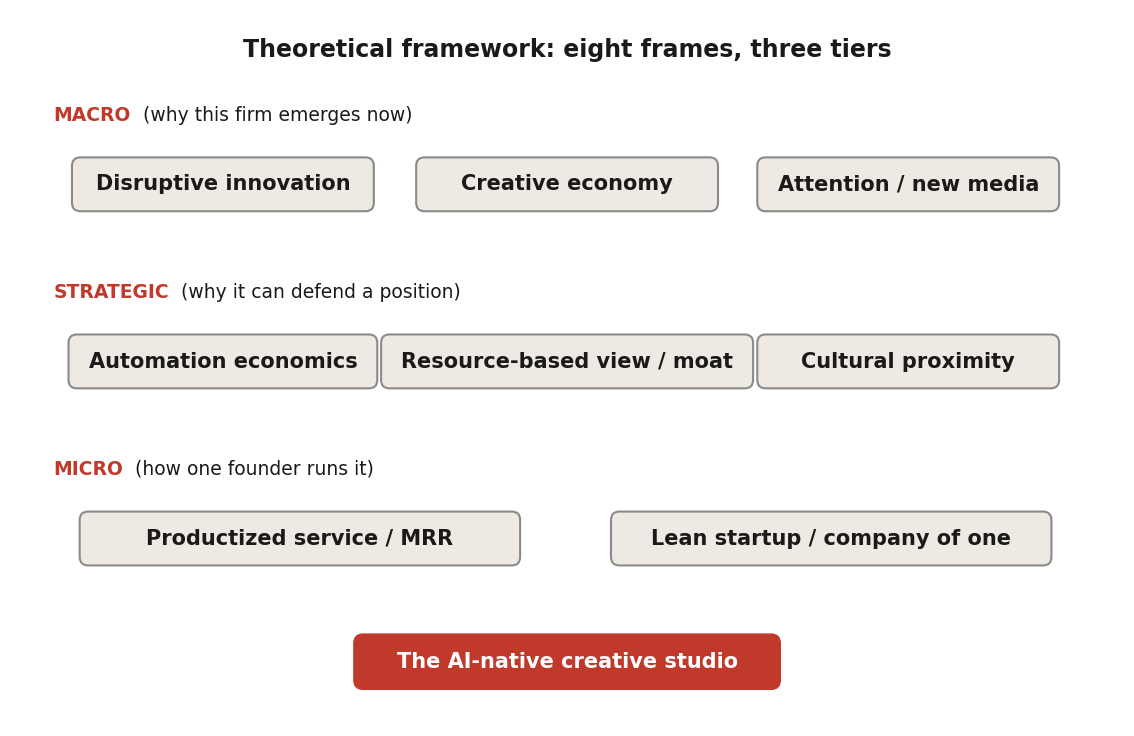
This chapter assembles the scholarly backbone of the study in eight frames, sequenced from the macro (why this kind of firm emerges now) through the strategic (why it can defend a position) to the micro (how one founder can run it). Figure 2 maps the frames onto those three tiers.
2.1 Disruptive innovation and diffusion
Christensen's theory of disruptive innovation distinguishes sustaining innovations, which improve products along dimensions incumbents' best customers value, from disruptive ones, which begin cheaper and lower-performing but take root in markets incumbents ignore, then move upmarket (Christensen, 1997). Rogers' diffusion of innovations supplies the demand-side mechanism, adoption spreading through innovators, early adopters, and successive majorities by perceived relative advantage and compatibility (Rogers, 2003), while Moore notes the chasm between visionaries and the pragmatic majority (Moore, 1991). AI-native production fits this pattern precisely: it first serves the small clients incumbent studios under-serve, at roughly a tenth of conventional cost, and the binding question becomes whether it crosses the chasm to the mainstream.[3, 4]
The framework also predicts the incumbents' response and its limits. Sustaining-innovation logic explains why established Indonesian studios will tend to add AI as a feature to their existing high-touch service rather than rebuild around it, protecting their margins and their staff, which is exactly the rational behaviour that opens the low end to a disruptor. Moore's chasm, however, is the real test for MORARI: the visionary early clients who adopt an AI-native studio for novelty differ from the pragmatic majority who adopt only on proof, references, and risk-reduction. The studio's emphasis on a visible portfolio and on hiding the machinery (Section 4.7) can be read as a deliberate chasm-crossing tactic, reframing a novel production method as a familiar, reliable service.[3, 4]
2.2 The creative economy
The creative economy reframes ideas and intellectual property as the primary inputs of value (Howkins, 2001); Caves supplies the microfoundations, modelling the contract between creative talent and the commercial apparatus that finances and distributes it (Caves, 2000), and Florida ties growth to where creative talent clusters (Florida, 2002). UNCTAD's measurement frame shows creative-services exports reaching US$1.4 trillion in 2022 and rising as a share of all services trade (UNCTAD, 2024). The frame locates MORARI inside a sector the Indonesian state treats as a strategic growth engine, and its distinctive move is to internalise the commercial apparatus that creative talent used to depend on.[5, 6, 7]
Caves's artist-versus-gatekeeper model is especially apt. In the traditional creative economy, talent depends on a commercial apparatus, financiers, agencies, distributors, that captures much of the value; MORARI's AI fleet absorbs that apparatus into software, letting a tiny team retain margin that previously flowed to intermediaries. UNCTAD's finding that creative services, led by software, are the fastest-growing and highest-value export class reinforces the timing: the studio rides a structural shift from creative goods toward creative services at the precise moment AI collapses the cost of producing them.[6, 7]
2.3 Attention economy and new media
Simon established that in an information-rich world attention, not information, is scarce: a wealth of information creates a poverty of attention (Simon, 1971). Jenkins describes convergence culture, where content flows across platforms and audiences actively redistribute it (Jenkins, 2006), and the contemporary venture-capital new-media lens argues every company must become a media company building owned audiences (a16z). When production cost approaches zero, the scarce resource becomes the ability to win attention, which is the premise MORARI both runs on and sells.[8, 9, 10]
Jenkins's convergence culture supplies the mechanism. In an environment where audiences migrate across platforms and redistribute content actively, owned-media surface area, produced at volume, is how a brand stays present in the flow rather than renting visibility through paid placement. MORARI's multi-brand, multi-platform publishing operation is a convergence-culture machine in this sense, and its documented experience of platform suppression when content was visibly AI-made is a reminder that, in the attention economy, distribution dynamics rather than production capacity are the real battlefield.[9, 10]
2.4 Automation and agentic-AI economics
The task-based framework models production as tasks allocated between labour and capital; automation creates a displacement effect offset by productivity and reinstatement effects (Acemoglu and Restrepo, 2022), while Autor stresses that automation both substitutes for and complements labour, raising the value of the non-routine tasks humans retain (Autor, 2015). Acemoglu's recent assessment tempers expectations, estimating only a minority of exposed tasks are profitably automatable (Acemoglu, 2024). The practitioner distinction between the rentable model and the assembled agent supplies the strategic corollary that durable value accrues to orchestration, not the model.[11, 12, 13]
The task-based view also disciplines the study's claims. It predicts not that AI eliminates creative labour but that it shifts the boundary, automating the routine and reinstating value in the non-routine, which is why MORARI retains a human founder for taste and judgment rather than aspiring to full automation. Acemoglu's estimate that only a minority of exposed tasks are profitably automatable functions as a built-in ceiling on the cost-saving story: it marks where human leverage and pricing power persist, and therefore where the studio should concentrate its scarce human attention.[12, 13]
2.5 Resource-based view and dynamic capabilities
The resource-based view locates sustained advantage in resources that are valuable, rare, imperfectly imitable, and non-substitutable (Barney, 1991), and dynamic-capabilities theory emphasises the firm's ability to integrate and reconfigure competences in fast-changing environments (Teece, Pisano and Shuen, 1997). For an AI-native firm this resolves the obvious objection, that anyone can rent the same models, by directing attention to the assembled system, proprietary data and taste, and the capability to re-tool faster than rivals.[14, 15]
The distinction between the static and dynamic versions of the theory matters here. A purely resource-based reading would catalogue MORARI's current assets, its prompt libraries, design systems, and brand data, as the moat; but in a tooling landscape that turns over monthly, any static asset is vulnerable to obsolescence. The dynamic-capabilities refinement locates the durable advantage one level up, in the firm's demonstrated ability to absorb new models and reconfigure its workflows faster than competitors, an organisational competence rather than a possession. This reframing is load-bearing for the study's conclusion that the moat is the system's adaptability, not any snapshot of its components.[15]
The moat is the system's adaptability, not any snapshot of its components.
Section 2.5 · Resource-Based View2.6 Cultural proximity and sovereign AI
Cultural-proximity theory holds that audiences prefer media culturally closest to them, giving local production a structural home-market advantage (Straubhaar, 1991); glocalization names the mutual constitution of the global and the local (Robertson, 1995). Because global generative models default to Anglophone norms, locally-rooted voice and IP become a defensible resource that foreign operators using the same models cannot easily replicate, cultural fidelity as a moat.[16, 17]
The sovereign-AI movement gives the theory contemporary force. When national actors invest in locally-trained models precisely because foreign defaults carry the wrong cultural assumptions, they are operationalising cultural proximity at the infrastructure layer; a studio that does the same at the content layer, in locally-tuned voice, idiom, and reference, occupies the corresponding creative niche. Robertson's glocalization frames the studio's original IP as indigenized global form rather than imported or purely local, which is also why that IP is hard for a foreign competitor using identical tools to replicate: the tacit cultural knowledge, not the model, is the scarce input.[16, 17]
2.7 Productized service and recurring revenue
A business model describes how a firm creates, delivers, and captures value (Osterwalder and Pigneur, 2010); productization converts bespoke services into standardized, fixed-price products, and the associated recurring-revenue logic makes retention, lifetime value, and acquisition cost the dominant variables. AI makes productization finally viable for creative work, because near-zero marginal cost permits fixed-scope packages rather than unpredictable project quotes.[18]
The recurring-revenue logic is the part of this frame the firm has not yet operationalised, and the study returns to it repeatedly. On the Business Model Canvas, the AI-native difference concentrates in two blocks, key resources and activities (an agent system rather than staff) and cost structure (variable labour collapsing into largely fixed software), which is what produces the abnormal margins documented in Chapter 4. The unfinished work is in the revenue-streams block: converting the proven, low-marginal-cost system from one-time builds into retained subscriptions is what would let the model's economics compound rather than reset with each project.[18]
2.8 Lean startup and the company of one
The lean-startup method treats a venture as an engine for learning under uncertainty through build-measure-learn cycles (Ries, 2011), and the company-of-one thesis argues that staying deliberately small can be a strategy in itself (Jarvis, 2019). Fused with automation economics, these frames describe the one-person firm that substitutes AI agents for a team, which is precisely the organisational form this study examines.[19, 20]
The company-of-one frame reframes the studio's small footprint as an intended design rather than a limitation: AI agents substitute for the team a traditional studio would hire, so the firm captures studio-scale output at one-person cost and retains the autonomy and margin the literature prizes. The more speculative one-person-unicorn idea, that a single founder plus AI agents could build a company of significant value without employees, finds in MORARI a concrete if early empirical instance, which is part of what makes the case worth documenting while the form is still taking shape.[19, 20, 2]
Read together, the frames form one argument: disruption and diffusion explain the opening; the creative and attention economies supply the market; automation economics is the causal engine; the resource-based view and cultural proximity are the two halves of the moat; productized-service theory is the business architecture; and the lean one-person firm is the organisational form. The study's contribution is to show these literatures converge in the AI-native creative studio.
2.9 Applying the framework to the case
Because the eight frames recur throughout the analysis, it is worth stating compactly how each maps onto a concrete feature of the firm under study. The mapping below is not decorative; it is the analytical scaffold of Chapter 4, and it is what lets the case be read as evidence for or against each body of theory rather than as mere description.
| Frame | Core claim | MORARI feature it explains |
|---|---|---|
| Disruptive innovation | cheap, low-end entrants move upmarket | serving the SMEs incumbents under-serve, at a tenth of the cost |
| Creative economy | ideas as the primary input; sector as growth engine | operating inside Indonesia's fast-growing ekonomi kreatif |
| Attention economy | attention, not information, is scarce | owned-media volume as the core product |
| Automation economics | tasks split between labour and capital | routine tasks automated, judgment retained by the founder |
| Resource-based view | advantage from VRIN resources | orchestration, data, and taste as the moat |
| Cultural proximity | audiences prefer culturally-close media | locally-tuned voice and original IP |
| Productized service / MRR | standardise and sell repeatedly | the template-per-client model (and its recurring-revenue gap) |
| Lean / company of one | staying small as a strategy | one founder plus an agent fleet |
Two cross-frame tensions are worth flagging now because they recur in the analysis. First, the resource-based view and the automation-economics frame together resolve the obvious objection that anyone can rent the same models: they redirect attention from the commodity input to the assembled, organised system. Second, the productized-service frame sits in unresolved tension with the firm's current practice, the theory prescribes recurring revenue while the firm presently sells one-time builds, a gap that becomes the study's central open question.
3. Methodology
3.1 Research design
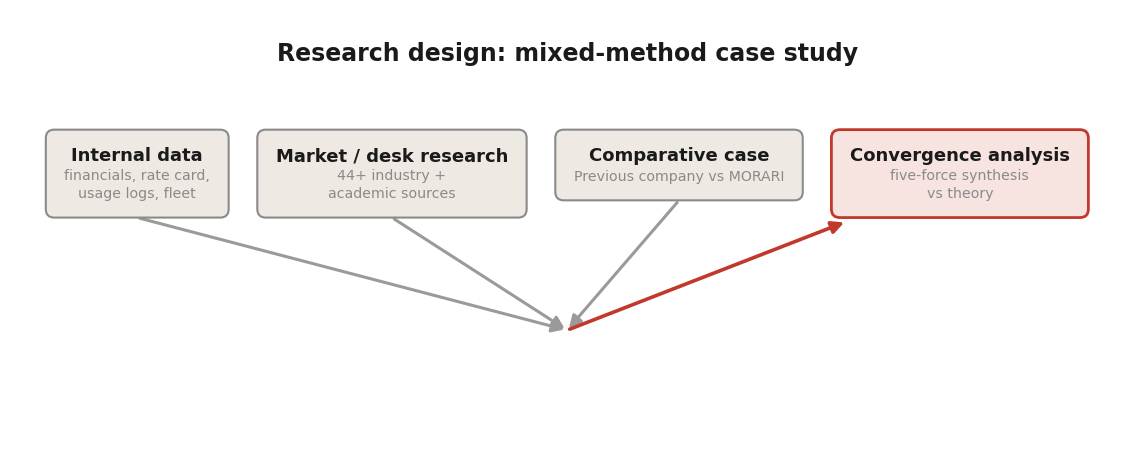
The study uses a single-case, mixed-method design. The case is chosen for its information richness rather than statistical representativeness, an appropriate strategy when the aim is to understand an emerging phenomenon in depth. Three evidence streams are triangulated: the firm's internal data, external market and academic research, and a comparative analysis against the predecessor venture.
3.2 Data sources
Internal sources include MORARI's rate card and capabilities deck, its productized-service quotations and a signed client contract, its generation-cost usage logs, and the architecture of its agent fleet, together with the founder's testimony on the history and economics of both ventures. The comparative source is the previous company's own financial model (cost structure and operating matrix). External sources comprise more than forty industry reports, official statistics, and academic works, cited throughout and listed in the references.
3.3 Analytical framework
The analysis proceeds in two moves. First, a four-force decomposition (economic, social, cultural, technological) establishes the external conditions, each grounded in quantitative data and, where possible, in the firm's own figures. Second, the operating model and strategy are read against the theoretical frames of Chapter 2, with the resource-based view used to test claims of defensibility. The comparative case (prior venture versus MORARI) serves as a natural before-and-after, isolating the effect of the AI-native cost structure.
3.4 Limitations
Three limitations are stated plainly. The study is a single case observed by its own founder, so it carries the risk of motivated reasoning, mitigated here by foregrounding disconfirming evidence and unproven claims. Several internal figures (notably a frequently-cited cost-saving estimate) are management estimates rather than audited numbers and are flagged as such. Finally, market-size projections from commercial research houses vary by source and are treated as indicative ranges, not facts.
3.5 Validity, reliability, and ethical considerations
Validity is pursued through triangulation: where a claim can be checked against more than one independent stream, internal data, external benchmark, and theory, it is, and figures resting on a single internal source are labelled accordingly. Construct validity is supported by anchoring each of the four forces to measurable indicators rather than impressions, and external validity is treated modestly, the single-case design supports analytical generalisation to the emerging firm-type, not statistical generalisation to a population. Reliability is supported by documenting the data sources, named internal artefacts and cited external works, so the chain of evidence is traceable.
Two ethical considerations apply. First, the researcher is the founder, a dual role disclosed openly and managed by foregrounding disconfirming evidence, refusing to count un-closed deals as revenue, and labelling estimates as estimates. Second, the firm's internal commercial figures, pricing, costs, and client terms, are reported only at the level of detail the argument requires; client identities beyond those already public are not used, and sensitive operational detail is generalised.
4. Analysis and Discussion
This chapter presents the study's core analysis. It opens with the predecessor venture (4.1), which functions as the empirical baseline, then decomposes the external opening into four forces (4.2 to 4.5), reads the operating model and strategy against theory (4.6 and 4.7), and closes with a synthesis that maps the case onto the framework of Chapter 2 (4.8).
4.1 The Precedent: A Prior Venture
MORARI began not from theory but from a venture that worked, ran out of road, and left a precise diagnosis. The previous company operated from September 2024 to December 2025 as a traditional production house with an experimental AI division. On roughly Rp250 million of capital it returned about Rp758 million over sixteen months, a threefold return.[21] Demand, in other words, was never the problem.
Demand, in other words, was never the problem.
Section 4.1 · The Precedent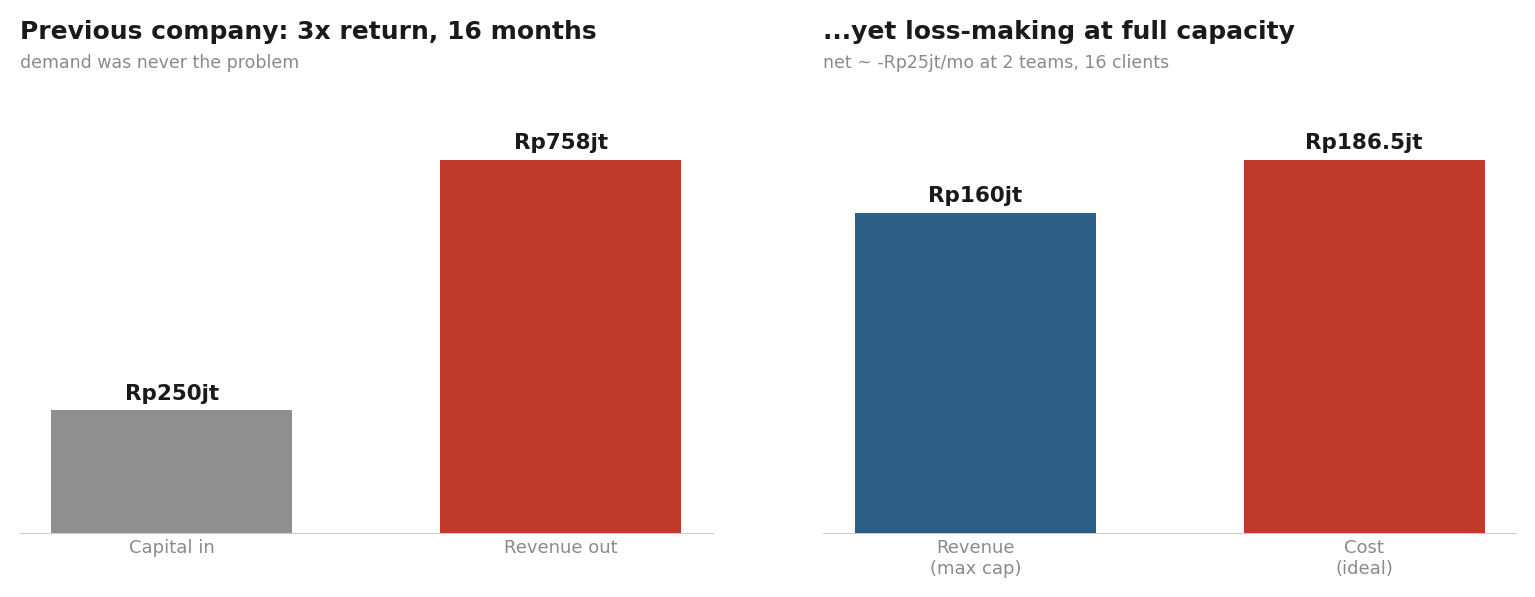
The problem was structural, and the firm's own cost model quantifies it. The model specified three operating scenarios whose burn ranged from about Rp43 million to Rp186 million per month against a five-division organisation of roughly twenty-five distinct roles (Table 1).[22] The decisive figure is not any single scenario but the capacity ceiling: even at maximum modelled capacity, two production teams serving sixteen clients for Rp160 million of revenue, the business still showed a net loss of about Rp25 million per month.[22] A human-staffed content studio of this design could not reach breakeven; growth made the loss larger, not smaller.
| Scenario | Monthly burn | Cost base | Blended rate/hr |
|---|---|---|---|
| Lean | Rp 72.5jt | 12 payroll + 5 mgmt + opex | Rp 113,281 |
| Ideal | Rp 186.5jt | fully staffed | Rp 291,406 |
| Actual (Sept) | Rp 42.7jt | 11 payroll + mgmt + other | Rp 22,243 |
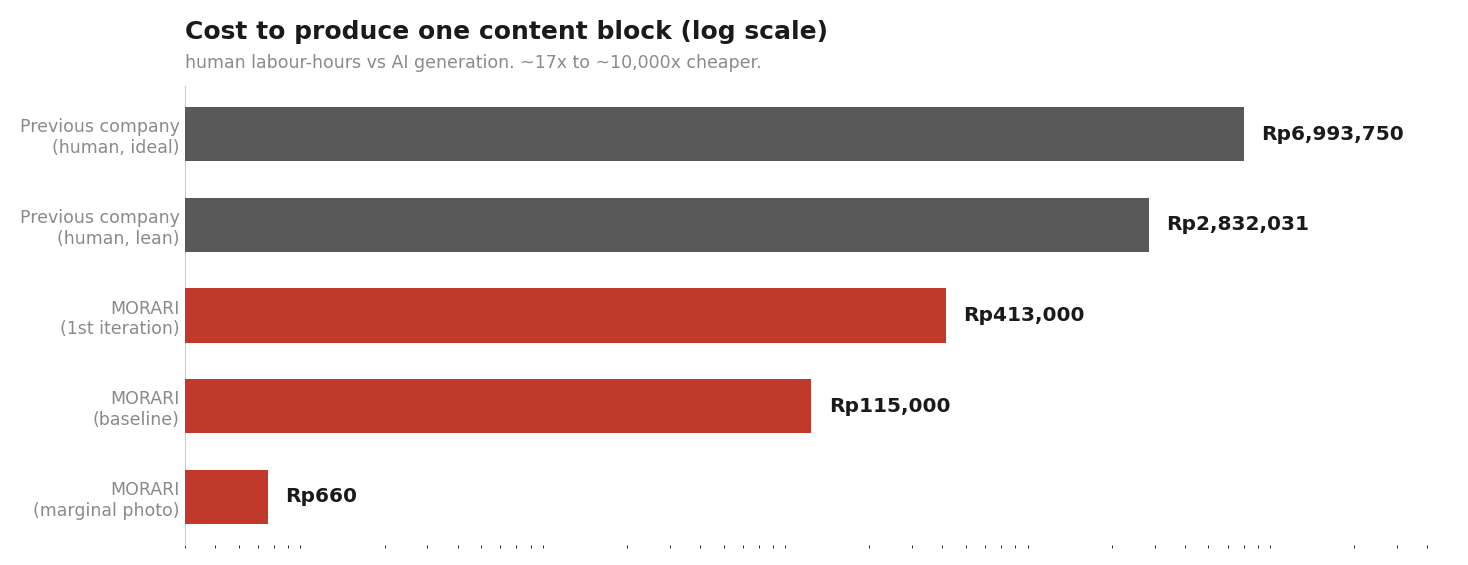
The reason sits in the per-asset labour. The previous company itemised roughly twenty-four to twenty-five human-hours to produce one content block, costing between about Rp2.8 million and Rp7.0 million at its blended rate.[22] MORARI produces the equivalent block for around Rp115,000 of generation cost in under two hours, and the marginal cost of one additional image falls to roughly Rp660.[21, 23] Figure 5 plots the gap on a logarithmic scale: a seventeen-fold to ten-thousand-fold reduction in cost per asset. Tellingly, the previous company had already priced AI against its own manual work, an AI photo set at Rp250,000 against Rp3,000,000 manual, so the opportunity was visible from inside the old company; what was missing was the cost structure, the contract mix, the decision speed of a single owner, and the maturity of the tools.[22]
4.1.1 The anatomy of the human cost
It is worth dwelling on where the previous company's money went, because it is exactly the structure MORARI later deleted. The venture carried a five-division organisation, external operations, creative strategy, production, internal operations, and a management layer, spanning roughly twenty-five distinct roles, from client manager and content strategist through videographer, motion designer, and prompt engineer to bookkeeper.[22] Producing a single content block consumed roughly twenty-four to twenty-five human-hours across briefing, shooting, data training, planning, creation, quality control, and delivery; at the venture's blended hourly rate this priced one block at between about Rp2.8 million and Rp7.0 million depending on the staffing scenario.[22] The cost was not waste or mismanagement; it was the irreducible labour content of craft production, and it scaled linearly with output.
The most revealing artefact in the venture's records is that the previous company had already built a side-by-side price list for manual versus AI delivery of the same services, a manual photo package at Rp3,000,000 against an AI set at Rp250,000, a manual short video at Rp7,500,000 against an AI equivalent at a small fraction of that.[22] The venture could therefore see the roughly twelve-fold per-unit gap from the inside. What it could not do was restructure around the gap fast enough. A multi-co-founder cap table slowed every decision (Frame 2.8's lean-iteration logic working in reverse), and the human payroll was a fixed monthly obligation regardless of how much of the work AI absorbed. The lesson MORARI drew was therefore not that AI is cheaper, which the previous company already knew, but that capturing the saving required collapsing the organisation itself, replacing twenty-five roles with an orchestrated agent fleet and a single contractor. That is a structural move a founder-led company can make and a committee-led one cannot, which is why MORARI was rebuilt around a single decision-maker.[21]
4.2 The Economic Dimension
The economic force has two halves: demand is large and growing, while the cost of supplying it is collapsing.
4.2.1 A large, fast-growing demand pool
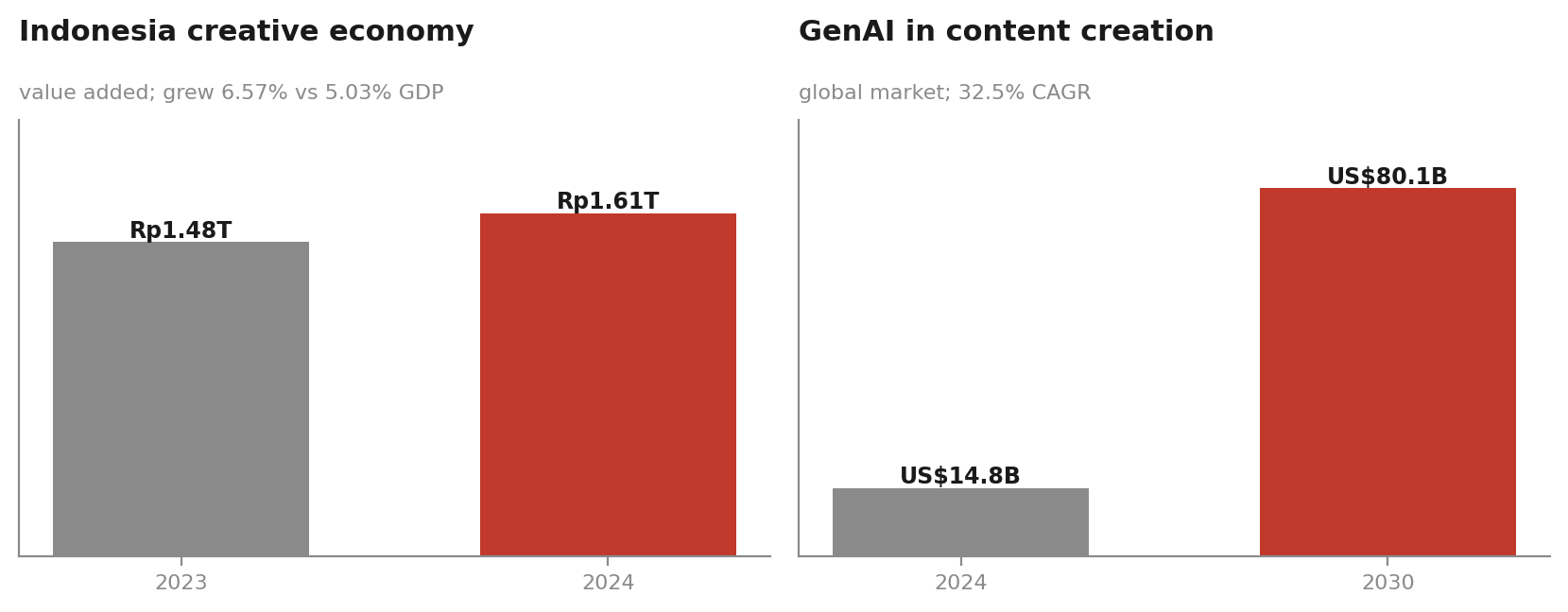
Indonesia's creative economy is among the largest in the world by contribution to GDP. Its value added rose from roughly Rp1,476 trillion in 2023 to about Rp1,611 trillion in 2024 (near US$90 billion), and the sector grew 6.57 percent that year against 5.03 percent for the wider economy, while employing some 27 million people, more than half of them under forty.[24, 25] The demand pool is not only large; it is outgrowing the economy around it. The wider Southeast Asian digital economy, surpassing US$300 billion in gross merchandise value in 2025, is the floor beneath it.[26]
4.2.2 The collapse of supply cost
On the supply side, generative AI is driving the marginal cost of content toward zero. Independent benchmarks place AI image generation at US$0.02 to US$0.15 per image against US$25 to US$500 for traditional photography, and a full sixty-second AI video at tens of dollars against US$5,000 to US$20,000 for a conventional shoot (Table 2).[27, 28] The market monetising this shift, generative AI in content creation, was US$14.8 billion in 2024 and is forecast at US$80.1 billion by 2030.[29]
| Asset | AI (MORARI) | Traditional | Reduction |
|---|---|---|---|
| 1 image / carousel slide | $0.04-0.13 | $150-500 | ~99.9% |
| 1 short video (8s) | $3.20-6.00 | $1,500-4,000 | ~99.7% |
| Full 60s multi-scene video | $34-45 | $5,000-20,000 | ~99.6% |
4.2.3 MORARI's unit economics
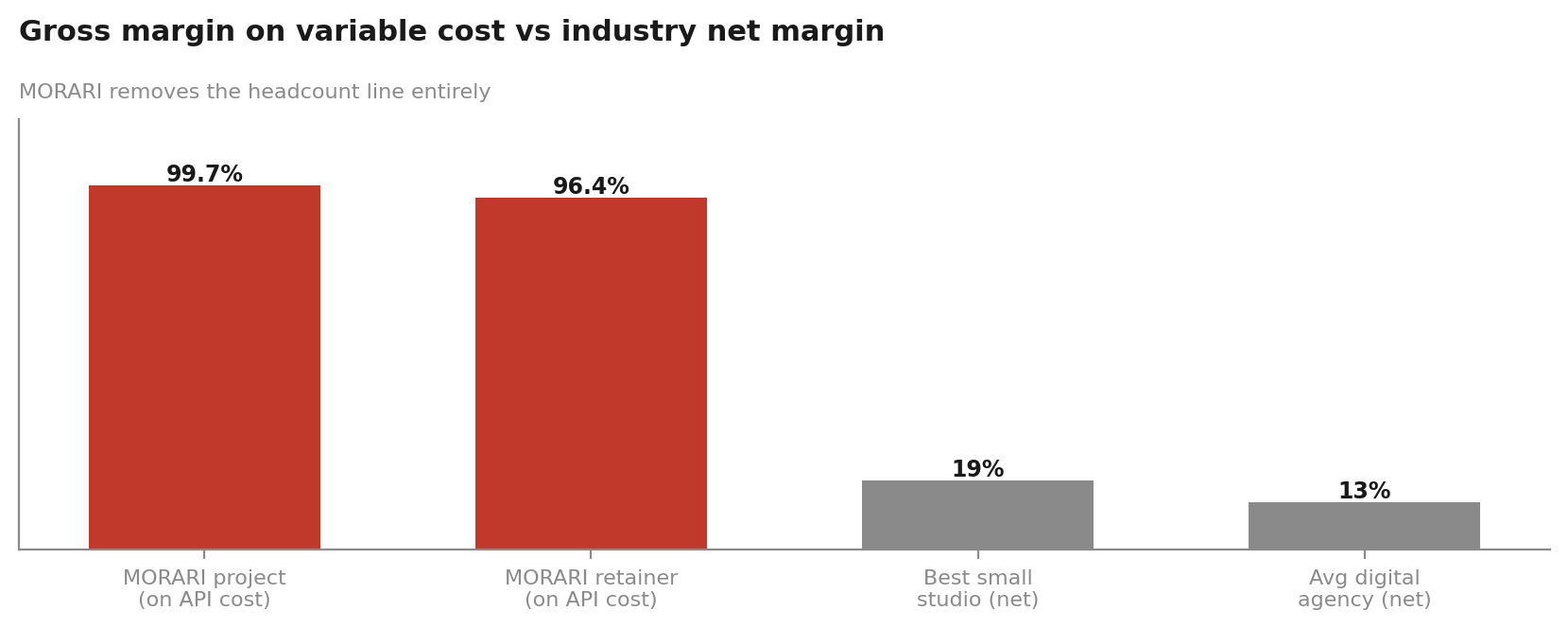
MORARI's rate card turns this into a business. It sells four tiers from a Rp1.1 million starter to a Rp20 million per month retainer, with a clean internal unit of account (one fifteen-second video equals three photo-equivalents) and a published marginal price of Rp100,000 per extra photo and Rp400,000 per extra video.[30] Because the true generation cost of a photo is under Rp1,000, the gross margin on variable cost runs near 96 to 99 percent, against a best-in-class small-studio net margin of about 19 percent and an industry average near 13 percent (Figure 7).[30, 31] The difference is the deleted headcount line: the entire human variable layer is one contractor at Rp4 million per month.[21] This is consistent with the resource-based reading developed in 4.6, the margin is not the model (which competitors rent identically) but the organisation around it.
4.2.4 The honest tension: cost solved, recurring revenue not
The economics of production are decisively solved; the economics of the business model are not. MORARI's flagship business-to-business product, a ten-bot media system priced from Rp115 to Rp397 million, is a one-time build that the client then operates itself, and the signed USS Networks engagement was a one-time Rp100 million deal in which roughly Rp78 million of list scope was given away as partnership bonuses to land it.[30, 21] The business-model literature is blunt that recurring-revenue firms grow faster and are valued several turns of EBITDA higher than project shops.[32, 33] MORARI has fixed the cost side that killed the previous company; converting its one-time builds into recurring revenue is the open frontier, and at present the only recurring line is the Rp20 million per month content retainer.
The literature gives this tension a precise shape. Project-based agencies typically transact at three to four times EBITDA, whereas those with a high share of recurring retainer revenue command five to seven times, and subscription-style businesses are valued several multiples higher still; recurring-revenue firms also grow materially faster because retained customers expand over time rather than having to be re-won.[33, 32] By that logic MORARI's flagship build optimises the wrong variable. By handing the client a system the client then operates, the studio maximises one-time delivery value while forgoing the retained, compounding revenue that its own near-zero marginal cost could comfortably sustain. The productized-service literature names this failure mode directly: a productized offer is powerful only when the standardised system is sold repeatedly at a recurring fee, not delivered once and released.[32]
There is a defensible counter-argument, which the study records rather than dismisses. A one-time build with a high headline price (the USS engagement closed at Rp100 million) converts cash immediately, requires no ongoing support obligation, and suits a one-founder operation that cannot yet staff a large managed-service book. The honest reading is that MORARI's current model is rational for its present scale but leaves the larger prize, the compounding recurring revenue that the cost structure uniquely enables, on the table. The strategic implication, developed in Chapter 5, is that the studio's next move is a packaging move, not a cost move.[21]
4.3 The Social Dimension
The second force is social: the scale of consumption, the democratization of production, and the structural gap between them.
Indonesia entered 2026 with about 230 million internet users (80.5 percent penetration) and 180 million social-media identities, up 26 percent year on year, each person averaging more than three hours a day on social media across nearly eight platforms (Table 3).[34] Attention converts directly to commerce: Indonesian social commerce reached roughly US$5.25 billion, and TikTok Shop's Indonesian gross merchandise value hit US$13.1 billion in 2025, up 111 percent, the second-largest such market in the world.[35, 36]
| Indicator | Value |
|---|---|
| Internet users | 230M (80.5%) |
| Social-media identities | 180M (+26% YoY) |
| Active creators | ~12M (largest in SEA) |
| TikTok Shop GMV (Indonesia, 2025) | US$13.1B (+111%) |
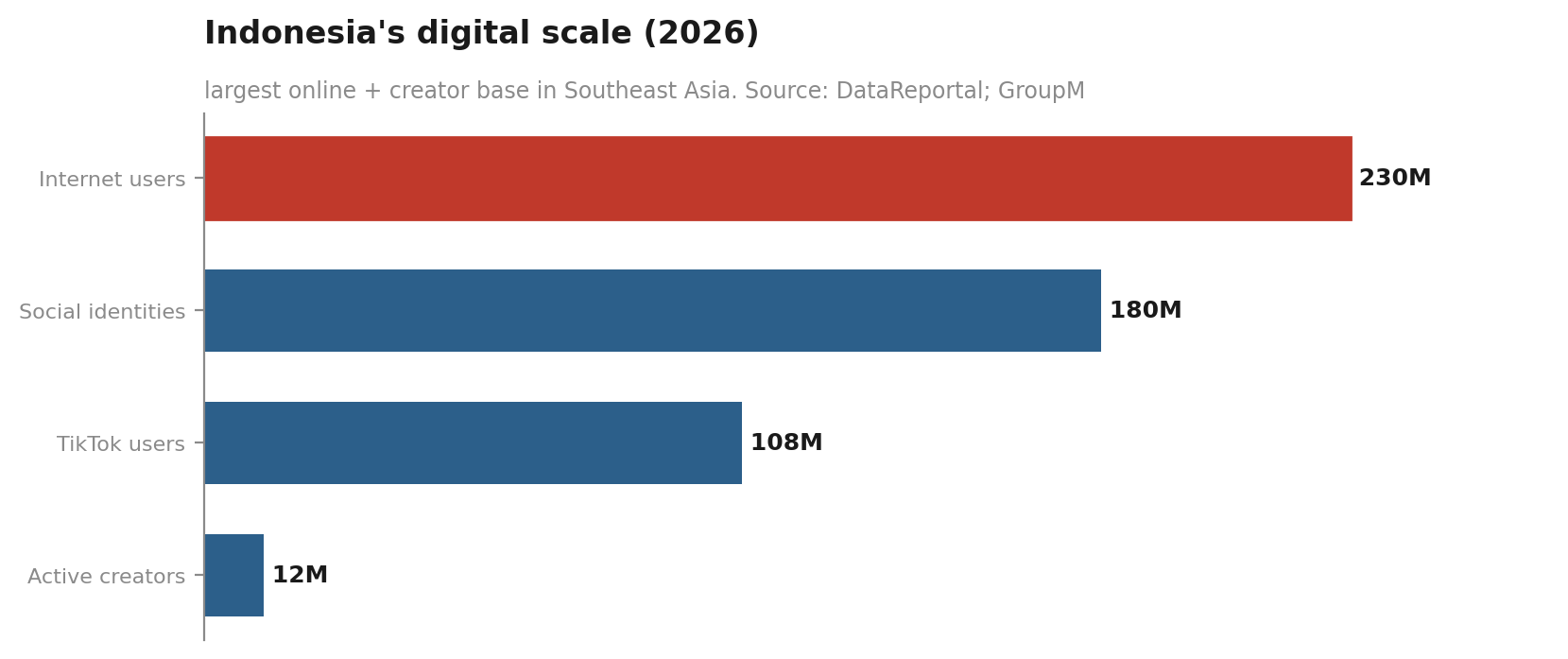
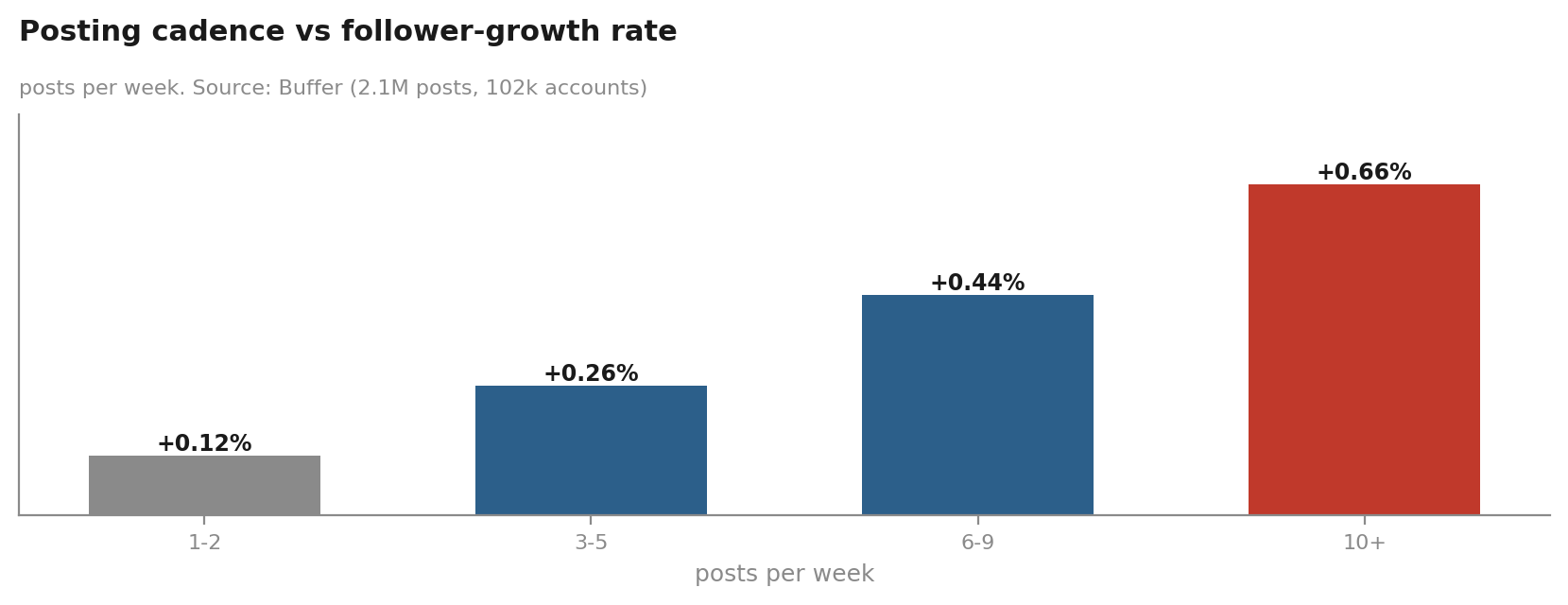
Generative tools let one person produce broadcast-quality work, so independent creators now compete with large studios on production quality.[37] Indonesia already has the most prolific creator base in the region, around 12 million creators, and its creator economy is forecast to grow from US$38.5 billion in 2025 toward US$112.7 billion by 2031.[38, 39] The decisive mechanic is cadence: a study of 2.1 million posts found follower-growth rate rising monotonically with posting frequency, three to five posts a week roughly doubling growth versus one to two (Figure 9).[40] Humans cannot sustain that frequency multi-brand at quality; an AI-native studio is, at heart, a machine for closing the resulting demand-supply gap at volume.
4.3.1 The commerce layer and the micro-creator shift
Two further features sharpen the social case. First, attention in Indonesia is unusually monetised: social and live commerce accounted for roughly four-fifths of the country's digital transactions in 2024, and a large majority of Southeast Asian consumers, with Indonesia near the top, have purchased through an affiliate or creator link.[35, 34] Content here is not a brand-awareness adjunct; it is the storefront. Second, engagement is migrating from a few mega-influencers to a long tail of micro and nano creators, whose median engagement rates run materially higher than larger accounts. The implication for a studio is structural: value is shifting toward high-volume, niche, always-on output rather than a handful of hero campaigns, which is exactly the output profile an AI-native operation can supply and a human-staffed one cannot.[38]
This connects directly to the attention-economy frame of 2.3. When production is no longer the bottleneck, the scarce resource becomes sustained, habit-forming attention, and the format that converts it best is short-form video, the highest-ROI content type marketers report.[41] The cadence finding (Figure 9) should be read alongside a quality caveat the same literature records: beyond roughly three posts a day, audiences fatigue and unfollow, so raw volume without curation backfires. The studio's answer, examined in 4.7, is a closed publish-audit-revamp loop that pairs high cadence with a quality gate, cadence multiplied by quality control, not cadence alone.[21]
4.4 The Cultural Dimension
The third force is the one most specific to Indonesia: a homegrown-IP boom, unusual AI optimism, and a sovereign-AI bet that turns cultural fidelity into a strategic asset, the cultural-proximity argument of 2.6 made concrete.
Indonesia's animation industry roughly tripled in a decade, from about Rp240 billion in 2015 to Rp800 billion in 2025, with revenue from local IP up some 280 percent.[42, 43] Local stories now scale globally: the animated feature Jumbo drew more than ten million cinema viewers, earned about Rp253 billion, and released in over forty countries, and its studio publicly urged the sector to move from one-off projects toward long-term IP, exactly MORARI's doctrine.[44, 45] The neighbouring Asia-Pacific webtoon market is forecast to grow from US$3.8 billion toward US$15.2 billion, and the state now treats animation as a national growth engine.[46, 43]
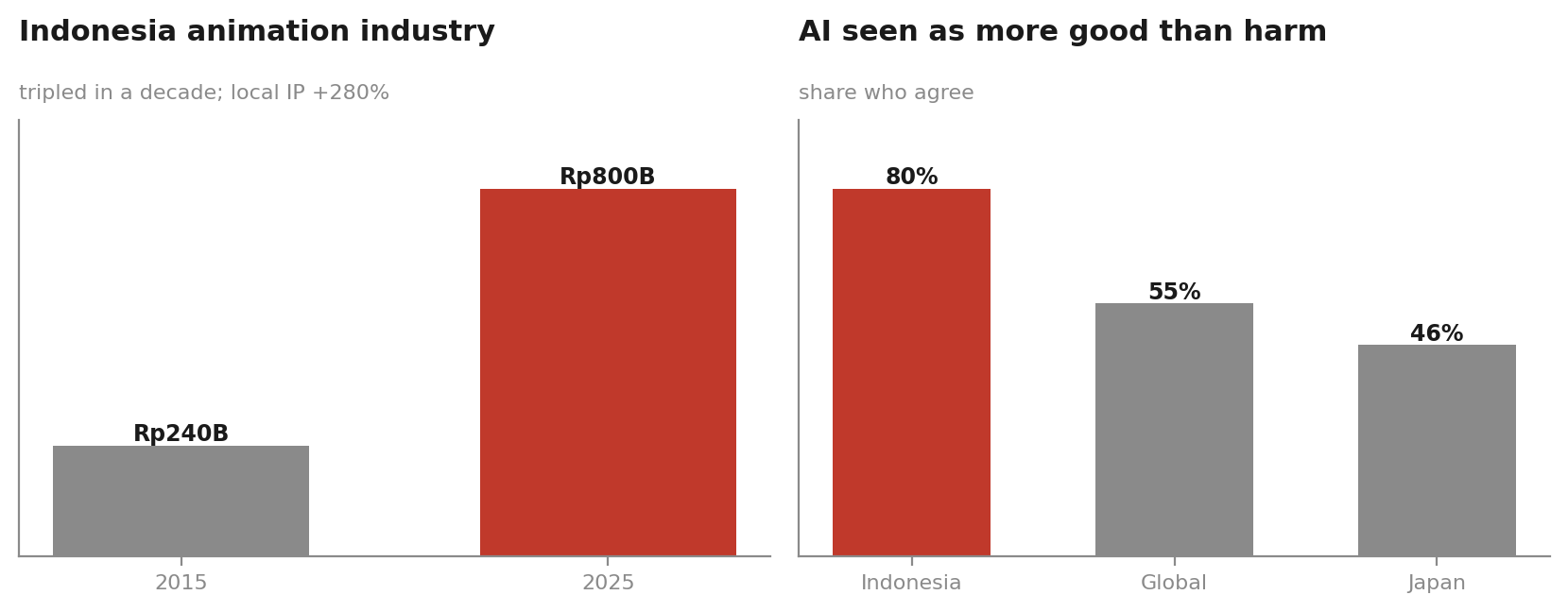
Indonesia is also among the most AI-optimistic societies measured, roughly 80 percent regarding AI as more beneficial than harmful against Japan's 46 percent, and it is betting that culturally-tuned AI is a sovereign asset: McKinsey estimates AI could add up to US$366 billion a year to GDP by 2030, and sovereign models such as the seventy-billion-parameter Sahabat-AI are built on the premise that a model not in your language carries bias.[47, 48, 49] This is where MORARI's own thesis lives. Its internal EPIK project argues that Indonesia is young, hyper-online, AI-fluent, and Web3-active yet lacks a culture-native language for technology, and closes that gap with a repeatable framing method, reframe a global topic into its Indonesian genesis, read it through cultural layers, treat creolization as the story, and cast Indonesia as protagonist.[50] The same logic drives the studio's original IP: OYABUN, a tender wholesome-yakuza anime, validated the high-fidelity production pipeline the studio now reuses, while BOMAT, a dark-funny doodle-on-real-Jakarta line, was chosen for a cheaper, higher-cadence lane and an ownable, culturally-specific corner no competitor can claim.[21]
4.4.1 The white space, the method, and the sovereign-AI tailwind
EPIK's thesis rests on five documented forces that together define the white space. Indonesia is young (Gen Z and Gen Alpha together are about 39 percent of the population, the world's third-largest Gen Alpha cohort); it is online at scale (well over 200 million users averaging more than three hours a day on social media); it is a fast AI adopter (around 92 percent of knowledge workers use generative AI, above the global 75 percent); it is a Web3 powerhouse (top-ten in global crypto adoption, first in Southeast Asia); and it sits inside a digital economy approaching US$100 billion.[50] The market is unquestionably present. What is absent is a culture-native language for technology, which is the gap EPIK exists to fill and the gap that makes a local studio, rather than a foreign one using identical models, the natural author of that language.
The method by which EPIK fills the gap is itself an asset, and the clearest expression of the cultural-proximity frame (2.6). The move is to take a global subject and frame it into its Indonesian genesis rather than presenting Indonesia as an adopter: find where the country is an origin point, read the subject through its cultural-historical layers, treat the local-global blend (creolization) as the story, root every claim in documented sources, and cast Indonesia as protagonist.[50] The studio's Bogor gastronomy study is a deliberate proof that the method survives scrutiny, reconstructing the city not as a place with good food but as the genesis point of Nusantara agro-culinary infrastructure through four documented layers, pre-colonial Sunda foodways, Dutch colonial agronomy, Peranakan creolization, and an Arab residual.[50] A method rigorous enough for a UNESCO dossier transfers cleanly to AI and Web3, which is the point: the method, not any single topic, is the durable resource.
This local-fidelity bet is reinforced by a national tailwind. Indonesia is building sovereign AI infrastructure and models, the seventy-billion-parameter Sahabat-AI serving Bahasa Indonesia plus Javanese, Balinese, and Bataknese, on the explicit premise that a model trained outside the culture carries the wrong defaults, while McKinsey estimates AI could add up to US$366 billion a year to GDP by 2030.[49, 48] A studio whose entire differentiation is locally-tuned voice and original IP is, in resource-based terms (2.5), holding a resource that is valuable, rare for foreign competitors, imperfectly imitable because it is tacit, and culturally non-substitutable, arguably the single most defensible asset an Indonesian AI-native studio can own.
4.5 The Technological Dimension
The fourth force is what makes the timing specific to now. Across 2023 to 2026 the generative stack matured from glitches to broadcast-ready output; by early 2026 multiple models produced native 4K video with synchronized audio, and venture funding into AI video alone reached US$4.7 billion in 2025.[51, 52] MORARI runs a best-tool-per-job stack across two vendors, Google Vertex for Veo video, Nano Banana imaging, and Chirp3-HD voice, and BytePlus ModelArk for Seedance, whose character-reference system holds a character consistent across shots in a way the alternative does not match (Table 4).[53]
| Modality | Primary model | Unit cost |
|---|---|---|
| Image (hi-fi) | Nano Banana 2 | $0.13 / image |
| Image (default) | Nano Banana / flash | $0.04 / image |
| Video (audio + 4K) | Veo 3.1 | $0.75 / sec |
| Voice | Chirp3-HD | $0.00003 / char |
| Reasoning | Anthropic Claude (Max) | $100 / month flat |
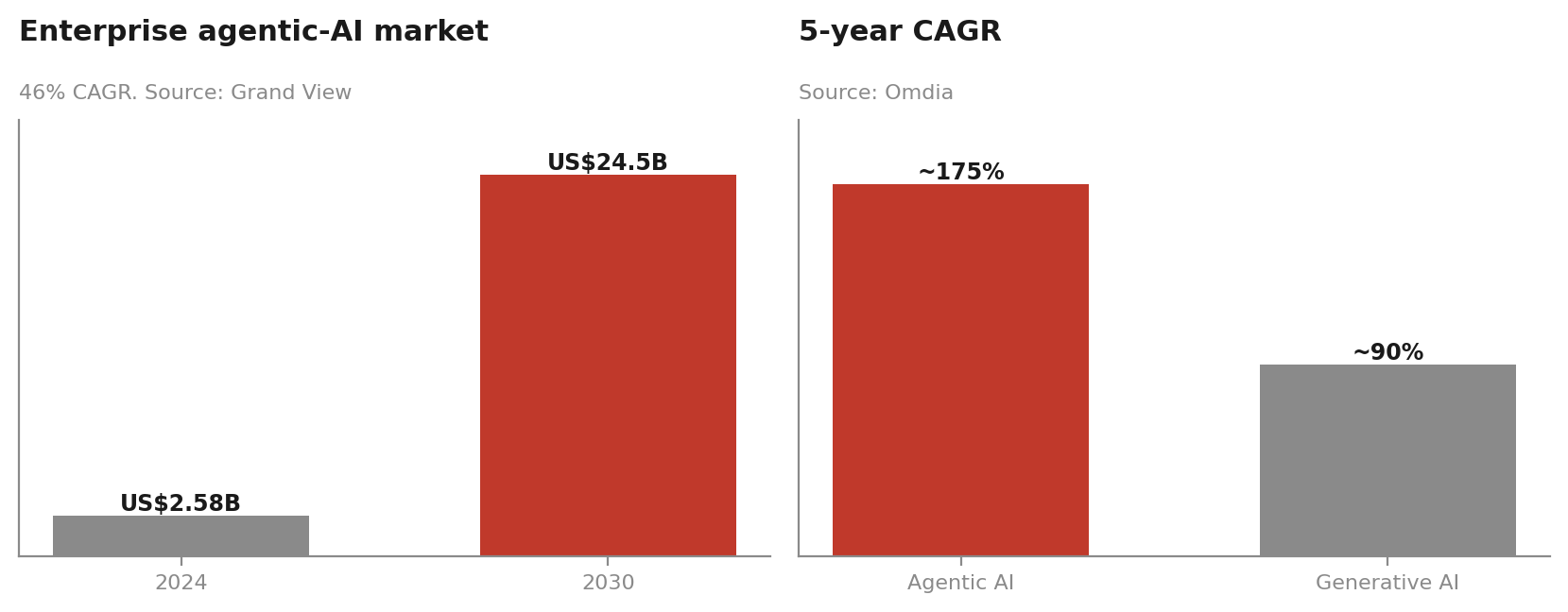
The defining economic feature is that the reasoning layer is a flat monthly subscription independent of volume, and the entire eight-agent fleet plus both of the firm's websites run on a single shared virtual machine; there is no headcount line and the all-in burn sits in the low hundreds of dollars a month.[53] The deeper shift is from AI tools to AI workers: Gartner expects 40 percent of enterprise applications to embed task-specific agents by the end of 2026, and the enterprise agentic-AI market is forecast to grow from US$2.58 billion in 2024 to US$24.5 billion by 2030, outpacing generative AI (Figure 11).[1, 54, 55] Crucially this stack is now accessible to lean teams, not just enterprises, which is what lets one founder run a multi-brand studio as a coordinated set of agents.[2]
4.5.1 The economics of a fixed-cost brain
The decisive technological fact for MORARI is not that generation is cheap but that the most important cost is fixed. The reasoning layer, the orchestrating intelligence that runs the whole fleet, is a flat monthly subscription that does not rise with output, while metered generation (images at cents, video at a few dollars a clip) is a thin variable layer, and the entire eight-agent operation plus both of the firm's websites run on one shared virtual machine.[53, 23] The result is an all-in burn in the low hundreds of dollars a month with no headcount line, which inverts the cost curve of a traditional studio. Where the previous company's cost rose with every additional content block, MORARI's marginal block is almost free once the fixed brain is paid for. This is the firm-level analogue of the macro finding that a modern solo operator's tooling stack costs a fraction of a staffed team's while delivering several times the output per hour.[2]
The two-vendor production stack is a deliberate capability choice rather than vendor indecision. The studio runs one provider's models for native-audio, high-resolution video and imaging, and a second provider specifically because its character-reference system holds a character consistent across shots, a capability the first does not match at the clip level and a hard requirement for original-IP work.[53] The ability to assemble and swap best-of-breed components per task, rather than betting on a single model, is precisely the dynamic capability that 2.5 identifies as the real moat in a fast-moving tooling landscape: the durable value is in the orchestration that can re-tool monthly, not in any one model that will shortly be superseded.
4.6 The Operating Model and the Moat
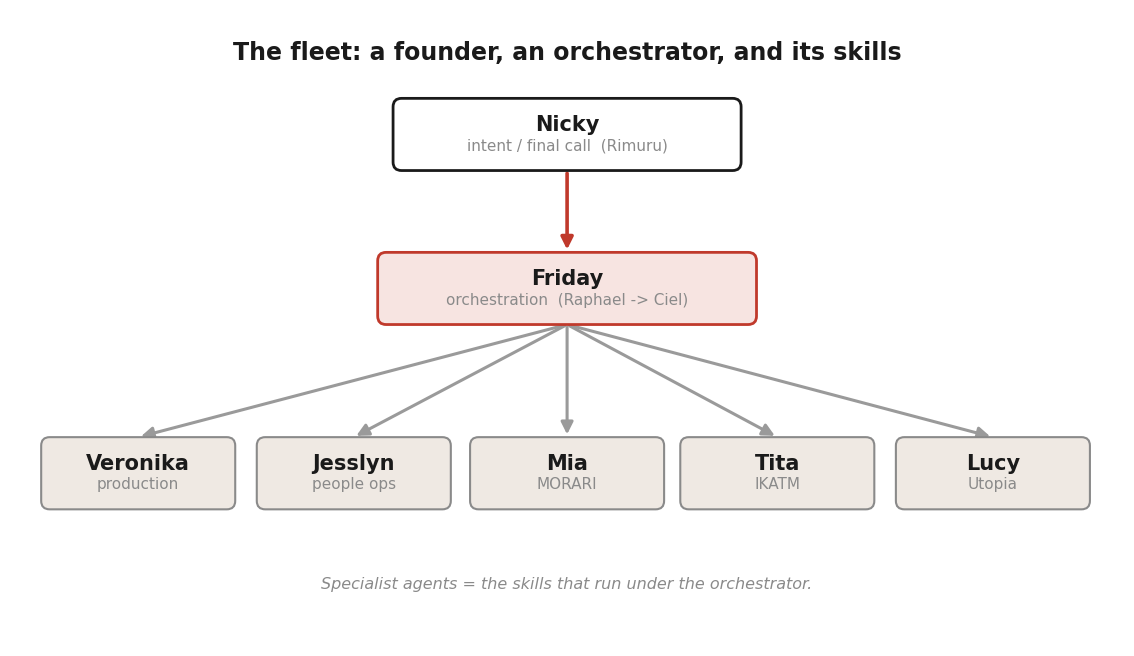
The forces explain the opening; they do not explain the shape of the firm. That came from a founder philosophy, the Raphael Doctrine, drawn from Japanese culture and holding that AI is best built as a devoted partner, the human keeping intent, taste, and the final call while an orchestrating intelligence runs the cognition and manages every other skill beneath it.[56] MORARI is that doctrine in operation: eight named agents run as persistent sessions on one machine, each with its own tools, memory, scheduler, and credentials, coordinated through a purpose-built message bus, acting on schedules, and governed by owner-only rules with human approval gates before any outbound action (Figure 12).[53]
Read through the resource-based view (2.5), this is where the studio's defensibility actually sits. Against the VRIN test, the foundation models are valuable but neither rare nor inimitable; the durable resources are the assembled orchestration architecture and accumulated process, the proprietary brand data and curatorial taste encoded over time, and the local relationships, all of which are path-dependent and causally ambiguous and therefore imperfectly imitable. The industry consensus has converged on the same point: the model is becoming the processor and the orchestrator the operating system, and the harness around the model is the single largest performance variable, larger than the model choice itself.[57, 58] Teece's dynamic-capabilities lens is arguably the more important frame, because the tooling changes monthly, the real moat is the capability to re-tool and re-lock workflows faster than rivals.[15]
4.6.1 How the orchestration actually works
The claim that the system is the moat is concrete, not rhetorical. MORARI's eight agents do not share one process; each runs as a persistent session with its own tools, memory, scheduler, and credentials, and they coordinate through a purpose-built message bus that exists precisely because consumer messaging platforms block bot-to-bot visibility, an in-house solution to a constraint that competitors using off-the-shelf tools also face.[53] The agents act unprompted on schedules (daily content drafting, weekly planning, persona-consistency audits, credential checks), persist their working state to files rather than to a context window, and operate under owner-only governance with human approval gates before any outbound action such as sending an email or publishing a post.[53] This architecture maps, almost line for line, onto the enterprise multi-agent governance pattern the 2026 literature now prescribes, least-privilege per-agent permissions, decision audit logs, and human-in-the-loop checkpoints, except that MORARI implemented it as a working studio before it was codified as best practice.
This is the operational meaning of the agent-versus-model distinction. A model answers a prompt and forgets; an agent couples a model to tools, memory, and a loop so that it acts; and a multi-agent system couples many agents under an orchestrator so that an organisation acts.[56] Everyone can rent the same models, so what cannot be cheaply copied is the assembled system, the bus, the schedulers, the locked design systems, the accumulated brand memory and voice profiles, and the founder's taste encoded into all of it. Those resources are path-dependent and causally ambiguous, the two conditions the resource-based view identifies as the source of imperfect imitability, which is why the durable advantage sits in the orchestration layer rather than in the commodity model beneath it.[14, 15]
4.7 Strategy and Go-to-Market
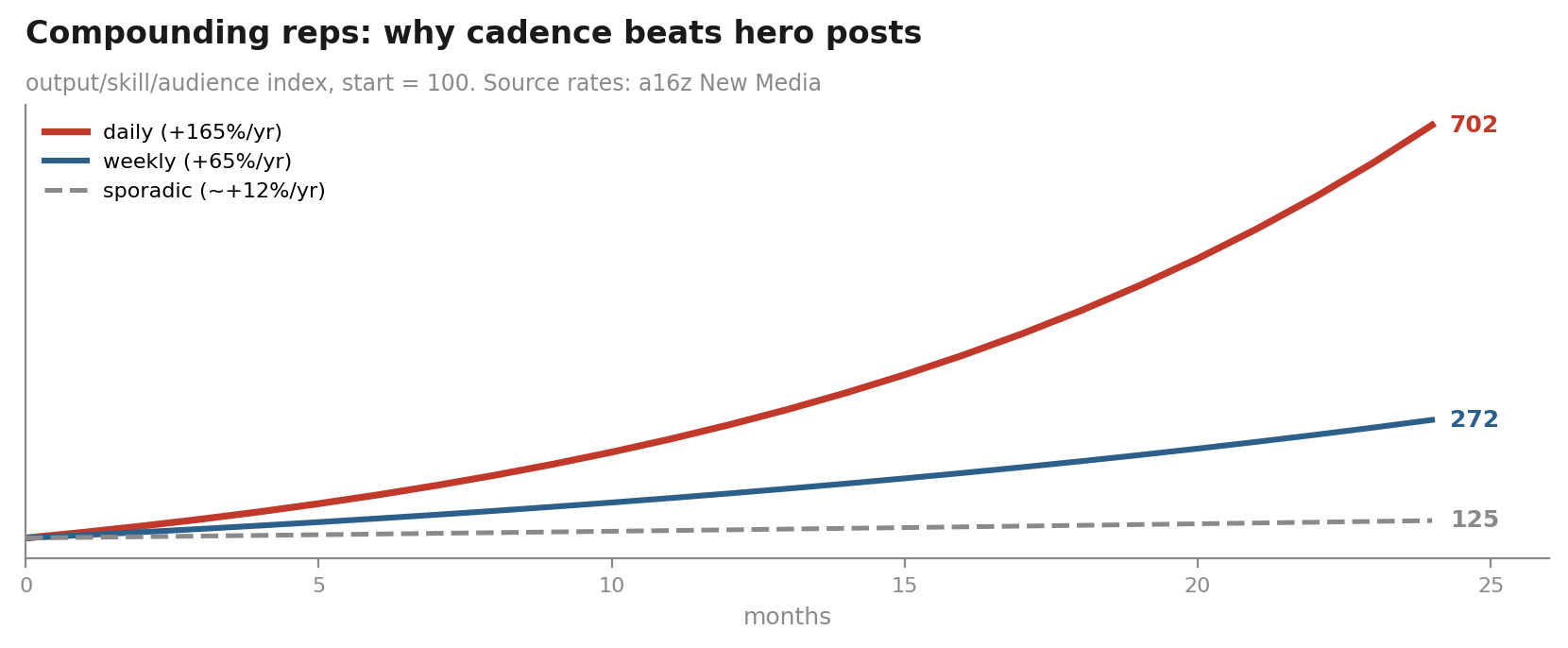
Two living documents convert the philosophy into a go-to-market. The first applies the new-media framing of 2.3: when distribution is democratized the moat is taste, legitimacy, and speed, and a studio can operate as a launches-as-a-service partner converting attention into durable brand power.[10] The same playbook supplies the discipline of compounding repetition, shipping weekly compounds to roughly plus 65 percent of output a year and shipping daily to plus 165 percent, so over two years the daily operator pulls far ahead on a compounding curve (Figure 13).[10] Humans cannot ship daily, multi-brand, at quality; AI-native production is what makes the high-cadence end of that curve reachable.
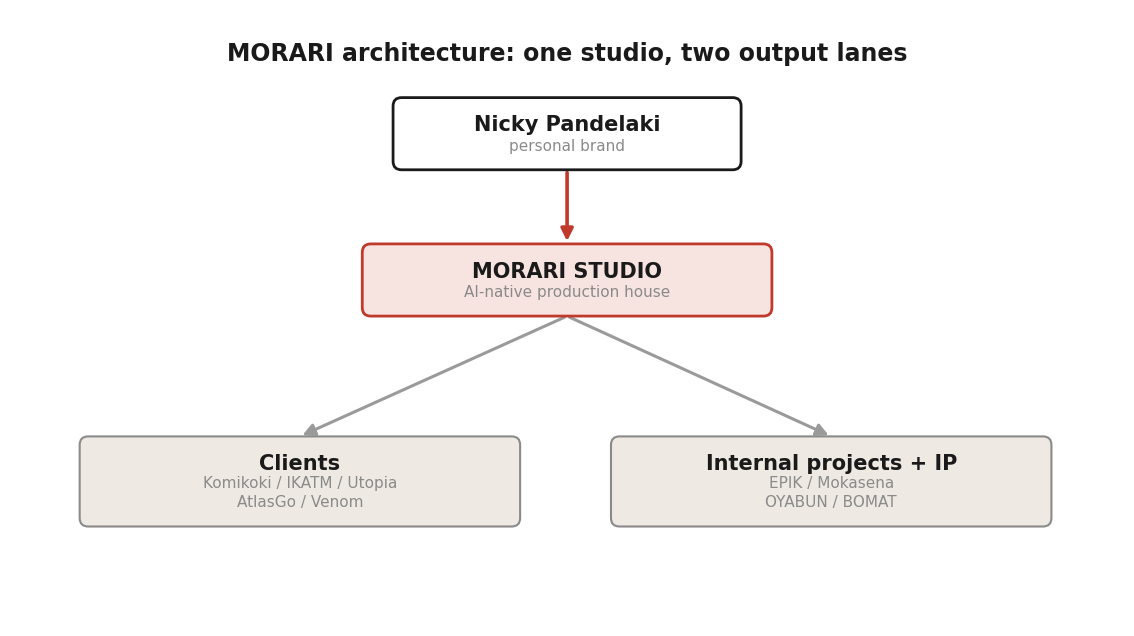
The model is a productized service in the sense of 2.7: build the system once for the house brand, then clone it per client at roughly a threefold markup, with each client a branch of a reusable template rather than bespoke work (Figure 14).[21] Strategically, MORARI ranks its own brand above its paying clients, consistent with the established finding that roughly 60 percent of marketing payback is long-term brand-building, so the studio's own output doubles as a compounding brand asset and a live showroom that lands and expands client accounts.[21, 59] An early lesson is built into the house style, because platforms demote visibly-AI content, the studio hides the machinery and leads with the work.[21]
4.7.1 The operating loop and the portfolio logic
The compounding curve is reached through a specific operating system, not willpower. MORARI's brand agents run a six-step weekly loop: propose a plan from a pillar rotation, draft two days ahead, quality-check one day ahead with the founder, publish, capture twenty-four-hour metrics, and revamp by cutting underperformers before the next plan.[21] This is the habit-formation and learning loop the new-media literature prescribes, rendered as scheduled jobs: the audit-and-cut step is the mechanism that keeps high cadence from degrading into the fatigue zone identified in 4.3, and it is why the studio can live at the daily end of the compounding curve without the burnout a human team would suffer.
The portfolio logic is equally deliberate and, on its face, counter-intuitive. MORARI ranks its own house brand above its paying clients in priority, building its owned media first.[21] Read against Binet and Field's finding that roughly sixty percent of marketing payback is long-term brand-building, this is rational rather than indulgent: the house output is simultaneously a compounding brand asset and a live showroom that demonstrates the capability to prospective clients, lowering acquisition friction.[59] The productized-service structure then turns each client into a branch of a reusable template at a roughly threefold markup over variable cost, and a land-and-expand motion, beginning with one account or service and growing into more, is the path by which a near-zero-marginal-cost studio compounds revenue, provided it closes the recurring-revenue gap identified in 4.2.[21, 32]
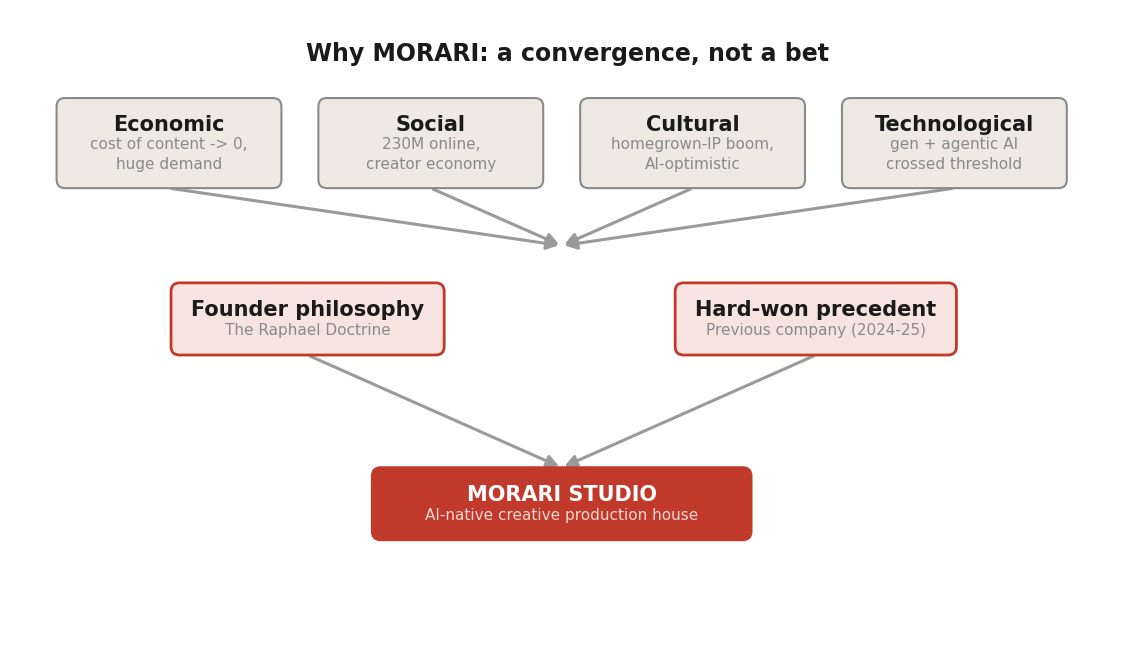
4.8 Synthesis: The Convergence Model
The four forces and two internal inputs do not act in isolation; they interlock, and the theoretical frames of Chapter 2 explain how. The economic force opened a widening gap between content demand and the cost to serve it (creative-economy and disruption theory). The social force filled that gap with insatiable, commerce-linked, high-cadence consumption (attention economy). The cultural force gave it a specifically Indonesian mandate and a defensible local resource (cultural proximity). The technological force made an entire organisation buildable by one person (automation economics). The Raphael Doctrine supplied the organisational design and, with it, the moat (resource-based view and dynamic capabilities), while the productized-service and company-of-one frames supply the business architecture and the form. The previous company supplied the operating diagnosis that pointed at exactly these fixes. Remove any single input and the studio does not function; together they made it close to inevitable. That interlock, not any one factor, is the answer to why MORARI was made.
| Input | Framed by | What it produces |
|---|---|---|
| Economic force | creative economy + disruption | a widening gap between content demand and the cost to serve it |
| Social force | attention economy | insatiable, commerce-linked demand for volume |
| Cultural force | cultural proximity | a defensible local-fidelity position |
| Technological force | automation economics | an entire organisation buildable by one person |
| Founder philosophy | resource-based view | the orchestration moat |
| Precedent (the previous company) | lean / company of one | the cost-structure diagnosis |
The table makes the study's central claim legible at a glance: no single row is sufficient and each is necessary. An AI-native studio with the technology but not the cultural position would be a commodity; one with the cultural position but the old cost structure would be the previous company; one with both but a committee instead of a founder could not move fast enough to capture either. MORARI exists because all six rows held at the same moment, which is why the study insists the right word is convergence rather than bet.
4.9 Threats to the Thesis
A study written by a founder owes the reader an explicit account of what could falsify its optimism. Four threats stand out. The first is commoditization: if the orchestration capabilities that constitute the moat (Section 4.6) are themselves absorbed into off-the-shelf platforms, the assembled-system advantage erodes and the firm is left competing on the commodity models everyone rents. The resource-based view offers only partial reassurance, the tacit, path-dependent elements such as taste, brand memory, and local relationships resist absorption, but the technical scaffolding is more exposed, so the firm's defence must migrate steadily from tooling toward data, IP, and relationships.
The second threat is platform dependency. The studio's distribution, and much of its clients' value, rests on a handful of social platforms whose algorithms it does not control; the documented zero-reach episode when content was AI-flagged is a small instance of a large risk. The third is key-person risk in its starkest form: a one-founder firm concentrates judgment, relationships, and taste in a single person, which is efficient but fragile, and which the company-of-one literature treats as an accepted trade rather than a solved problem. The fourth is the one the study has foregrounded throughout, the unproven recurring-revenue model: if the firm cannot convert its cost advantage into retained, compounding revenue, it remains a highly efficient project shop rather than a durable enterprise.
None of these threats negates the thesis; each qualifies it. Together they convert the study's conclusion from a claim of inevitability into a claim of conditional advantage: MORARI was made because a genuine convergence opened a genuine opportunity, and whether that opportunity becomes a durable business depends on choices, about revenue model, data, and IP, that remain ahead of it.
5. Conclusion and Recommendations
5.1 Findings
On the first research question, the conditions that made an AI-native studio viable in 2026 were a convergence of four measurable forces with an enabling philosophy and a prior venture's lessons, not a single trigger. On the second, the unit economics are decisively favourable on the cost side: against the previous company's documented loss of about Rp25 million per month at full capacity, MORARI operates at a 96-to-99-percent gross margin on variable cost, having reduced cost per asset by between seventeen-fold and ten-thousand-fold. On the third, the defensible advantage does not lie in the rentable models but, per the resource-based view, in the assembled orchestration system, the accumulated process and taste, and the locally-rooted brand and IP, the system and the culture, not the model.
These three findings reinforce one another. The convergence (first finding) is what made the favourable economics (second finding) achievable at all, and those economics in turn fund the patient brand-and-IP building that constitutes the moat (third finding). The causal chain runs from external opening to internal capability to defensible position, which is why the study treats the four forces not as backdrop but as the load-bearing first half of the argument. It is also why a competitor cannot replicate MORARI by renting the same tools: the tools are necessary, but the convergence, the timing, and the accumulated, path-dependent resources are not purchasable.
5.2 The open question
On the fourth question, the study is deliberately honest. The recurring-revenue thesis is not yet proven. As of mid-2026 MORARI has a handful of proof-of-concept clients at cost recovery and no full-rate paying clients at scale; its flagship build hands the operating keys to the client, currently improving the client's economics more than the studio's own, and a frequently-cited internal cost-saving figure remains an estimate rather than an audited number. The model is proven in cost and capability; it is not yet proven in sustained, full-margin, recurring demand.
It is worth being precise about what would count as proof. The model would be validated by a book of retained, full-rate clients on recurring terms, with healthy retention and a lifetime-value-to-acquisition-cost ratio comfortably above the threshold the business-model literature treats as sustainable, sustained over enough months to rule out novelty effects. Until then, the honest status is that MORARI has demonstrated a production capability and a cost structure that are genuinely new, while the enterprise that monetises them durably is still under construction.
5.3 Recommendations
Three recommendations follow. First, convert the productization advantage into recurring revenue: reposition the flagship from a one-time build toward a managed, retained service, where the near-zero marginal cost can compound into monthly recurring revenue rather than be handed to the client. Second, invest deliberately in the resources the resource-based view identifies as the moat, the proprietary brand-voice data, the locked design systems, and the original IP, since these, not the models, are what competitors cannot rent. Third, treat the house brand and original IP (OYABUN, BOMAT) as the long-term, compounding equity they are, and instrument them with the retention and lifetime-value metrics the business-model literature prescribes.
These recommendations share a logic: each moves the firm's centre of gravity from the input it has already mastered, cheap production, toward the assets the theory marks as durable, recurring relationships, proprietary data, and owned IP. They are also sequenced by urgency. The recurring-revenue shift is the most pressing, because it is the difference between a studio that is efficient and one that is valuable; the resource investment is the most strategic, because it compounds; and the IP instrumentation is the most patient, because original properties mature over years. A founder-scale firm cannot pursue all three at full intensity at once, so the practical guidance is to ring-fence a fixed share of capacity for the recurring-revenue experiment even while client project work pays the bills.
5.4 Future research
This is a single, founder-observed case; the natural extensions are comparative studies of other AI-native studios, longitudinal tracking of whether the cost advantage translates into durable margins as the tooling commoditizes, and audited measurement of the cost-saving and retention figures estimated here. The broader contribution stands regardless: a grounded account of an emerging organisational form, the AI-native, agent-run creative firm, observed from one of the world's most social-first and AI-optimistic markets.
Three extensions are especially promising. A comparative study of several AI-native studios across markets would test which of MORARI's features are idiosyncratic and which are general to the form. A longitudinal study tracking margins as the tooling commoditizes would address the central durability question directly. And an audited treatment of the cost-saving and retention figures estimated here would convert management claims into verified evidence. Each addresses a limitation this single, founder-observed case cannot resolve on its own.
5.5 Theoretical and practical contributions
Theoretically, the study contributes a grounded, integrated reading of an emerging firm-type. The eight bodies of theory in Chapter 2 are usually deployed in isolation; this case shows them converging in a single organisational form, the AI-native, agent-run creative studio, and demonstrates that the resource-based view, rather than industry positioning, is what explains the firm's defensibility once the underlying models are commoditized. It also offers a developing-economy, creative-industry vantage on the automation-economics and one-person-firm literatures that are otherwise dominated by enterprise and global-North cases.
Practically, the study yields a decision-relevant conclusion for the founder and for similar operators: the AI-native production advantage is real and large on the cost axis, but cost advantage alone is not a business. The durable prize is a recurring-revenue model that lets near-zero marginal cost compound, and the resources worth investing in, proprietary brand data, locked systems, and original IP, are precisely those the resource-based view marks as non-imitable. For policy, the case illustrates how Indonesia's creative-economy, AI-adoption, and sovereign-AI tailwinds can be captured at the scale of a single small firm, suggesting that support for micro-scale AI-native creators may carry outsized returns.
The name encodes the thesis. MORARI joins Morgan, the founder's daughter, with the Indonesian ari, day or sun, a personal company built on an impersonal wave.[21] The honest framing is not that a studio was rebuilt but that one was reincarnated, the same creative ambition returned with a leaner body, a partner intelligence, and far better timing. The cost question is answered; whether the studio can turn its proven production edge into durable recurring revenue is the question that remains, and it is the measure of how good it can become.
Appendix A: MORARI Rate Card and Productized Tiers
| Tier | Price | Quota (photo-equivalents) |
|---|---|---|
| Starter | Rp 1,100,000 | 5 photos or 1 video (15s) |
| Standard | Rp 2,700,000 | 12 photos or 3 videos |
| Premium | Rp 5,000,000 | 24 photos or 6 videos |
| Monthly retainer | Rp 20,000,000/mo | 30 photos + 6 videos, dedicated agent |
| Tier | Total | Headline scope |
|---|---|---|
| A (Lean) | Rp 115,000,000 | 10 bots, DM + scheduling + dashboard |
| B (Standard) | Rp 260,000,000 | + AI chief of staff, smart scheduling |
| C (Premium) | Rp 397,000,000 | + ideation engine, custom admin UI |
Appendix B: Comparative Cost Structure (Prior Venture vs MORARI)
| Dimension | the previous company (human) | MORARI (AI-native) |
|---|---|---|
| Team | ~25 roles, 5 divisions | 1 founder + 1 contractor + agent fleet |
| Monthly burn | Rp 43-186jt | ~Rp 5-10jt |
| Cost per content block | Rp 2.8-7.0jt | ~Rp 115,000 |
| Net at full capacity | -Rp 25jt / month | positive (96-99% gross margin on variable) |
| Cycle time per block | ~24-25 hours | under 2 hours |
Note: MORARI burn and the 96-99 percent margin are gross of the fixed contractor and subscription lines and are management figures; the previous company figures are from the venture's own cost model. See Section 3.4 (limitations).
Appendix C: EPIK's Five Forces (the cultural-mandate data)
The five data-backed forces behind MORARI's internal EPIK project, which underpin the cultural-dimension analysis in Section 4.4.
| Force | Key indicator |
|---|---|
| A young country | Gen Z + Gen Alpha ~39% of the population; world's 3rd-largest Gen Alpha cohort |
| Online at scale | 200M+ internet users; over three hours a day on social media |
| AI fast-adopter | ~92% of knowledge workers use generative AI (vs ~75% global) |
| Web3 powerhouse | top-ten global crypto adoption; first in Southeast Asia |
| Large digital economy | GMV approaching US$100B; e-commerce ~72% of it |
Appendix D: Prior-Venture Per-Block Labour Breakdown
The human-hour content of a single the previous company content block, the cost MORARI's agent fleet replaced (Section 4.1.1).
| Task | Hours |
|---|---|
| Initial brief | 0.5 |
| Shoot for material | 5.0 |
| Data training | 0.5 |
| Content planning | 1.5 |
| Content creation | 12.0 |
| QC + revision | 4.0 |
| Delivery + reporting | 1.5 |
| Total per block | ~25.0 |
At the venture's blended hourly rate this priced one block at roughly Rp2.8 to 7.0 million depending on staffing scenario. MORARI produces the equivalent for about Rp115,000 in under two hours.
Appendix E: Selected Market Indicators by Dimension
| Dimension | Indicator |
|---|---|
| Economic | Indonesia creative economy ~Rp1,611T (2024, ~US$90B); GenAI content market US$14.8B to US$80.1B by 2030 |
| Social | 230M internet users; 180M social identities; TikTok Shop Indonesia US$13.1B (+111%) |
| Cultural | animation Rp240B to Rp800B; Jumbo 10M+ viewers; webtoon APAC US$3.8B to US$15.2B; AI-to-GDP US$366B by 2030 |
| Technological | AI-video VC US$4.7B (2025); agentic-AI market US$2.58B to US$24.5B; 40% of enterprise apps agentic by 2026 |
References
- 40% of Enterprise Apps Will Feature Task-Specific AI Agents by 2026. Gartner. link ↗
- The One-Person Unicorn: Solo Founder Guide 2026. NxCode. link ↗
- Christensen, C. M. (1997). The Innovator's Dilemma. Harvard Business School Press.
- Rogers, E. M. (2003). Diffusion of Innovations (5th ed.). Free Press.
- Howkins, J. (2001). The Creative Economy: How People Make Money from Ideas. Penguin.
- Caves, R. E. (2000). Creative Industries: Contracts Between Art and Commerce. Harvard University Press.
- UNCTAD (2024). Creative Economy Outlook 2024. link ↗
- Simon, H. A. (1971). Designing Organizations for an Information-Rich World. Johns Hopkins University Press.
- Jenkins, H. (2006). Convergence Culture: Where Old and New Media Collide. NYU Press.
- Andreessen Horowitz. What Is New Media? link ↗
- Acemoglu, D. & Restrepo, P. (2022). Tasks, Automation, and the Rise in U.S. Wage Inequality. Econometrica 90(5). link ↗
- Autor, D. H. (2015). Why Are There Still So Many Jobs? Journal of Economic Perspectives 29(3). link ↗
- Acemoglu, D. (2024). The Simple Macroeconomics of AI. Economic Policy 40(121). link ↗
- Barney, J. B. (1991). Firm Resources and Sustained Competitive Advantage. Journal of Management 17(1). link ↗
- Teece, D. J., Pisano, G. & Shuen, A. (1997). Dynamic Capabilities and Strategic Management. Strategic Management Journal 18(7).
- Straubhaar, J. D. (1991). Beyond Media Imperialism: Asymmetrical Interdependence and Cultural Proximity. Critical Studies in Mass Communication 8(1). link ↗
- Robertson, R. (1995). Glocalization: Time-Space and Homogeneity-Heterogeneity. In Global Modernities. Sage.
- Osterwalder, A. & Pigneur, Y. (2010). Business Model Generation. Wiley.
- Ries, E. (2011). The Lean Startup. Crown Business.
- Jarvis, P. (2019). Company of One: Why Staying Small Is the Next Big Thing for Business. Houghton Mifflin Harcourt.
- Nicky Pandelaki, founder testimony and internal operating data (the previous company and MORARI Studio), 2026.
- Previous-company master cost structure and master matrix (internal financial model), 2024-2025.
- MORARI API usage tracker and audited generation-spend logs (internal), 2026.
- Creative Economy Adds $90 Billion to Indonesia's GDP. Jakarta Globe. link ↗
- Indonesia's Creative Economy GDP Surpasses National Growth. Tempo. link ↗
- e-Conomy SEA 2025. Google, Temasek, Bain & Company. link ↗
- AI Photography vs Traditional: ~90% Cost Savings. Sozee. link ↗
- AI Video Production ROI and Cost Analysis. Genra. link ↗
- Generative AI In Content Creation Market, 2030. Grand View Research. link ↗
- MORARI Studio rate card, capabilities deck, and 10-bot media-system quotation (internal), 2026.
- Agency Profit Benchmarks 2026. Move at Pace. link ↗
- Complete Guide to Productized Services. Assembly. link ↗
- Digital Marketing Agency Valuation Multiples 2026. Breakwater M&A. link ↗
- Digital 2026: Indonesia. DataReportal / We Are Social. link ↗
- Indonesia Social Commerce Market 2025-2030. Ken Research. link ↗
- TikTok's Southeast Asia GMV doubles to $45.6B; Indonesia $13.1B. TechNode Global. link ↗
- Technology-enabled democratization: generative AI and content marketing. ScienceDirect. link ↗
- Indonesia's Creator Economy: 12M creators. NetInfluencer (GroupM). link ↗
- Indonesia Creator Economy Market Forecasts 2031. Mobility Foresights. link ↗
- How Often to Post on Instagram (2.1M-post study). Buffer. link ↗
- Indonesia animation sector triples amid IP boom. Asia IP. link ↗
- Animation Industry Revenue Surges 279.53%. Kemenekraf. link ↗
- Jumbo: Indonesian Animated Global Breakout. Deadline. link ↗
- Jumbo, Visinema and Indonesia's animation IP strategy. Variety. link ↗
- Asia-Pacific Webtoon/Comics Platforms Market. HTF Market Insights. link ↗
- The 2025 AI Index Report (Public Opinion). Stanford HAI. link ↗
- AI could add up to US$366B to Indonesia's GDP by 2030 (McKinsey, via sovereign-AI coverage). link ↗
- Indosat and GoTo unveil a sovereign AI (Sahabat-AI). Fortune. link ↗
- EPIK Living Document and framing method (internal), 2026.
- Artificial Intelligence in Creative Industries: Advances Prior to 2025. arXiv. link ↗
- AI Video Generation: From 2024 Glitches to 2026 Cinema. gaga.art. link ↗
- MORARI stack inventory and agent-fleet architecture (internal), 2026.
- Enterprise Agentic AI Market Size, 2030. Grand View Research. link ↗
- Agentic AI outpacing generative AI growth. Omdia. link ↗
- The Raphael Doctrine: A Research Companion. MORARI Studio internal, 2026.
- The Orchestrator Is the Product. The Model Is a Commodity. Zencoder. link ↗
- The Harness: The Moat for AI Model Providers? UncoverAlpha. link ↗
- Les Binet & Peter Field, the 60:40 brand-building rule (IPA Databank). link ↗